Tower of Heaven is a tough, rule-stacking platformer

tower of heaven final overall imp

Much like with Persist, I am finding myself drawn to platformers that really mix the genre up so that it is no longer simply about jumping left to right, down to up. Those simplistic actions are totally fine, given that that’s where this genre really began with Super Mario Bros. and Alex Kidd in Miracle World, but eventually the premise wears thin, and there needs to be something else tossed into the machine to create a different style of play.

Again, in Persist, you lost abilities, like being unable to swim in water or even jump, which made traditional platforming problematic and demanded you figure out a way around regardless. In Fez, which is probably more puzzler than platformer, you could rotate the level to traverse to new areas, find hidden secrets, and see everything in a new light. Braid had you playing with time. Sonic the Hedgehog, which I’ve never been good at, placed more of an emphasis on speed than straightforward platforming, and 3D titles like Jumping Flash! took advantage of a rather unique and challenging perspective for platforming purposes, with the camera locked in first person mode, which made leaping to extreme heights both exhilarating and disorienting. And awesomely, I could list other examples, but I think that’s decent for now.

Well, in Askiisoft’s Tower of Heaven, our game of the moment, there’s a rule book you acquire early on, and if you don’t follow the rules, you die–plain as paper. Designed to look like a Game Boy romp of old, this challenging platformer looks more innocent than it really is. By the time you pick up the second or third rule, it’s just as difficult as the masochistic platformers of this past generation–I guess I can say that now since we’re moving on to the next one with the PlayStation 4 and Xbox One finally exiting their respective dungeons–namely, Super Meat Boy and I Wanna Be the Guy. It’s difficult and leaves nearly no room for error, especially once you can’t go left, touch the side of blocks, and even touch other living beings. But I guess I’m getting ahead of myself.

The plot. Yup, there’s a plot. You are a lost soul, represented as a dark shadow of a human figure, and you are attempting to climb a…tower. Where does it go? Well, the game’s title should clue you in, but I couldn’t tell if that was meant to be taken literally or figuratively. A mysterious voice from above does not believe you can do it and begins to throw wrenches into your plans when it becomes clear you are unwilling to walk away from your heavenly goal. There’s some religious text at the very end that kind of confused me and felt like it was there to be “deep” and “thoughtful”, but really added little to the story. In each level, your goal is to reach the staircases and continue up. However, as you progress, the voice from above will place specific restrictions on you (such as you can no longer hit the left key or touch the side of walls), and these rules eventually stack on top of each other, meaning you have to constantly be aware of all the things you can’t do, as well as what you can. At one point, you weren’t even allowed to check the rules menu; if you hit the button to bring up the list, you exploded into pixels. It’s a fantastic gameplay idea, though it makes for tough towering.

All that said, here’s about nine minutes of me going through the motions for Tower of Heaven‘s first few levels. Warning: my mic audio is very high and airy, and I’m still tinkering with my settings to learn what works and what doesn’t for recording purposes. Again, if anyone has any tips, I’ll take ’em. Just throw them at my head; I’m using OBS now to record gameplay footage and a LogiTech headset.

I played more after the video ends and was able to beat Tower of Heaven after about twenty or twenty-five minutes on the final few levels. I came very close to giving up entirely though, that’s how challenging it got. When the rule states that you can no longer touch living beings like butterflies and grass, well…you begin to notice that stuff is all over the place. Anyways, the ending was simply okay, if a bit muddled in its own revelations and heavy religious tone, but I dug it nonetheless. Just like in VVVVVV, you get a stats screen at the end, and mine showed that I died a total of 154 times, which I am totally not ashamed of. If you’re into retro games with some challenge, this one is definitely worth checking out.

Learning the nature of Primal’s demon realms all over again

primal-ps2_2_891745-550x309 copy

I made a grave error when beginning Primal, staying headstrong on this lofty goal of mine to beat five specific videogames in 2013. If I can see its credits roll, it’ll be the third title I can check off my digital list, which I’ll consider a fine achievement. However, that’s only if I don’t goof up again, like I did when choosing the lesser of my two PS2 memory cards to save the game’s data on. Could’ve really used some advice from Scree on that one.

If you’ll recall, I was able to snag a used PS2 memory card some years back, but there’s some corrupt data on it that I just can’t delete, no matter how many times I try; however, I’ve been able to save other game info on there just fine, like my vital progress in Harry Potter: Quidditch World Cup and Secret Agent Clank. So it definitely isn’t completely broken. Just randomly, I guess. Alas, after playing for two hours of Primal and getting to just before the game’s first boss battle, my save data became corrupted and wouldn’t load. Eek. My heart turned to stone each and every time the “load error” message came up. So I had to switch over to my mainstay memory card and delete some info, such as Tony Hawk Pro Skater 3 character save BS and whatever little progress I made in Wallace & Gromit: The Curse of the Were Rabbit, and start all over again. At least this time around I knew puzzle solutions and could skip all the cutscenes immediately.

So yeah, I’ve played about four or so hours now of Primal–that’s the first two hours twice, and then a wee bit more once I got my saving stuff in order. It’s good. I mean, it’s always been good, but I think the game still holds up really well in 2013, mostly for its Buffy the Vampire Slayer-esque story, cheeky characters, and larger-than-realm scope. Seriously, the realm of Solum feels absolutely massive even if, technically, it’s not, and I have already found myself getting lost going from the forum to the hunting camp to the colosseum, though you could probably also blame that on the lack of an on-screen mini-map. Granted, I generally associate dark, snowy worlds with time standing still thanks to The Lion, The Witch, and The Wardrobe, and Solum comes across as a bitter, uninhabitable home full of strange people and customs.

Some of Primal‘s gameplay mechanics are not as awesome as I remember them, and now that I actually play it, controller cradled in hands, I’d prefer to have no combat at all, but that’s just a pipe dream. Like in Silent Hill 2, combat is an essential part of the game, even if it is clunky and obtrusive and strangely designed around the left and right triggers. Restoring and harvesting health from fallen foes is tedious, and the climbing, now spoiled by the likes of one-button speedfreak Assassin’s Creed, feels pretty cumbersome. But all of that can be dismissed simply to hear Scree and Jen talk, as their banter feels genuine, and you can really watch Jen grow closer to the little gargoyle in a natural way, which might sound odd, given that she’s technically dying in a hospital and has been taken to a realm between realms to do something heroic and find her stolen band boyfriend.

I’m approaching the part in Primal where I always stop and…walk away, much like I had in the previous two entries checked off my list–Chrono Cross and Silent Hill 2. I just need to power on and not be afraid to use a walkthrough when I get stuck because, surprisingly, this game doesn’t highlight interactive objects in a bright yellow glow or put a giant arrow over them like many gamers are coddled today. You have to be observant and aware and willing to think outside the castle wall box. However, sometimes the answer is not easy to deduce without any clues, and I’d rather have someone else tell me what it is then to give up on Primal yet again. I have to see this spunky goth girl, also a coffee bar waitress, discover her destiny. I have to.

2013 Game Review Haiku, #42 – Tower of Heaven

2013 games completed tower of heaven

Reach the tower’s top
By jumping, but the rules keep
Adding up, amen

These little haikus proved to be quite popular in 2012, so I’m gonna keep them going for another year. Or until I get bored with them. Whatever comes first. If you want to read more words about these games that I’m beating, just search around on Grinding Down. I’m sure I’ve talked about them here or there at some point. Anyways, enjoy my videogamey take on Japanese poetry.

2013 Game Review Haiku, #41 – Grand Theft Auto V

2013 games completed gta 5 franklin bike copy

Three bad men team up
For the biggest score ever
Drive, shoot, open world

These little haikus proved to be quite popular in 2012, so I’m gonna keep them going for another year. Or until I get bored with them. Whatever comes first. If you want to read more words about these games that I’m beating, just search around on Grinding Down. I’m sure I’ve talked about them here or there at some point. Anyways, enjoy my videogamey take on Japanese poetry.

Waiting for you, Silent Hill 2, to unravel in my mind

silent_hill_2_hole_by_parrafahell-d3h4ttd

Silent Hill 2 is pretty fascinating from all angles. After nine or ten hours played and one ending unlocked, I can say that confidently. Maybe even intelligently. It is a marvel of the horror gaming genre, as well as what a lot of “scary” games–now and forthcoming–should aim for in terms of story-telling, atmosphere, and sound design. It doesn’t have to be jump scares all the time. However, no one should try to ape its combat system, as that aspect continues to be the worst part of this survival horror franchise and should be stripped out completely in lieu of more puzzles or just quiet exploration. Everything else though? Psychologically unnerving, but in a good way. Probably.

Before we go any further, let it be said: spoilers. I’m going to be talking openly and veraciously about what happens in Silent Hill 2, from beginning to middle to end, taking out my handy magnifying glass and leering at everything not covered by thick fog, unless it’s too disturbing to do so. If you have not fully experienced this game, just stop reading and go play it. It’s not terribly long. In fact, I was checking out the Xbox 360’s Achievements list for the version included in the most recent HD collection, which you probably shouldn’t get, and one of them is for beating the game in under three hours. Oh my. It took me just around ten; however, it’s not a game one should rush through on their first visit, but it also doesn’t overstay its welcome. So go play, let Silent Hill’s disturbing horrors take over your mind, let the unsettling sound design raise the hairs on your arm, let the bosses be bothersome–and then come back here for some discussion.

From what I can tell, no one goes to Silent Hill voluntarily. In Silent Hill 2, James Sunderland finds himself drawn to the eerie town after receiving a mysterious letter from his wife Mary. One minor problem: she’s been dead for several years now. That’s the simple setup and main goal for the whole game: find Mary. But as James progresses and meets both monsters and men hidden in the infamous PlayStation 2 fog tech shrouding the town in secrecy, another story begins to be told, one without many words, but lingering there on the edge of reality nonetheless. This is all about James, not Mary. For James is a Very Bad Man™, an antihero, a sad stick of a human being, and deserves to be punished. Everything stems from his horribleness.

See, Mary was ill and dying. The game never explicitly says–how shocking!–from what, but you get the impression that it’s not the flu. Just some bad business. And then Mary died. Unfortunately, James killed her before the disease could and then blocked out the memory. Mary did not die three years ago; she got sick three years ago, and he killed her very recently. He goes to Silent Hill to face his literal demons; in fact, once you learn this, the original letter from Mary disappears from your inventory, solidifying the reason for being there. It was not a crime of compassion, but rather selfishness and shame, because James no longer wanted to look at his sick wife being sick–the disease was apparently quite disfiguring–and began to find himself attracted to the nurses in the hospital, his love going astray.

Along the way, James comes across other people trapped in Silent Hill. There’s Angela, an evasive young girl who we later learned was abused by her father. Eddie, who is puking his guts out upon first meeting him, seems to have a bit of a mean streak because the world was always ragging on him for his weight. Laura, a young girl, just keeps running away from James at every chance–and rightly so. Lastly, there’s Maria, a woman he finds in the park; strangely, she resembles Mary both physically and in her voice, but she’s also different in minor and major ways. To me, these people are not just here for shits and giggles, but represent a vital portion of James as a whole: Eddie is his uncontrollable hatred of others, suicidal Angela is his hatred of himself, Maria is the love he has for himself, and Laura is everything innocent that remains, for she is able to run around Silent Hill carefree, not seeing a single monster. Or they could be lost souls, struggling with their own problems at the same time James is.

Of course, you can’t talk about Silent Hill 2 without taking a look at everyone’s favorite big baddie to cosplay as–Pyramid Head, the iconic blade-wielding monster. He pops up now and then to torment James some more by killing Maria, a woman that closely resembles his Mary, over and over and over again. You fight Pyramid Head all by your lonesome a few times in the game, but you can never damage him, never stop him. Basically, Pyramid Head represents the fact that James can’t avoid his guilt, that the selfish murder of his dying wife will haunt him always. He’s pretty terrifying, especially his first appearance, which implies that he is sexually assaulting one of the nurse monsters, which adds to James’ reprehensible behavior; you can over-analyze as you see fit.

For the majority of the game–let’s say 75%–you know nothing. You are just a man named James in a strange town looking for your wife. You come across monsters, you find other people trapped, and you work your way from building to building, looking for answers. It’s only when you finally get that big answer that you can begin to question everything revolving around James, including the man himself.

A lot of all the above theories are implied or simply hidden in the fog of one’s mind, and without any kind of examination, Silent Hill 2 comes across as merely a man trapped in Purgatory, fighting off or running from scary monsters. By that alone, it’s still a fantastic journey, but the fact that it is so layered is beyond rewarding. Other games in the franchise are more straightforward, focusing on a cult and the obvious evil powers floating around the fictitious town, though I believe Silent Hill: Downpour dives into some psychological issues. I find Silent Hill 2 fascinating for the questions it doesn’t answer or bring up or even hone in all; everything is there for interpretation, and it’s up for you to figure out how the story goes.

Chances are high I’ll never play Silent Hill 2 again. The “Leave” ending is canonical for me, but I looked up some of the other ways this goes down–even the jokey ones–on YouTube, and have seen everything I wanted to see, including how the puzzles change on different difficulty settings. At some point, I’ll move on to see what Silent Hill 3 is all about, but nothing will ever be as successful at burrowing into my brain like James Sunderland’s visit to a foggy town to heal himself of the horrible choices he made. Nothing.

Land the plane, bury the hatchet in Grand Theft Auto V

gta V bury the hatchet mission rant

Hello again. I’m back to moan and groan about Grand Theft Auto V, but this time it’s not about a glitch, rather an examination of my inept plane-flying skills and strange, faulty mission design stuff on Rockstar’s part. Also, the stupid tug of Trophies, the poor man’s Achievements, both of which I keep telling myself I really don’t care about any more, but find myself still interested in unlocking nonetheless. Le sigh.

I’ve made a big push to see GTA V‘s main storyline come to a close–something I want dead and done before we ring in the new year because I want to move on to at least one of the other two new PS3 games I’ve recently added to my collection, namely Sly Cooper 4–and I think I’m a few missions away from the big finale. That’s good. So long, that is, as I don’t get distracted with side stuff or simply driving around, blasting Eddie Murphy’s “Party All the Time” and zooming through red lights. Anyways, the other night I finished up “Bury the Hatchet,” a story-heavy mission with some graveyard shooting and flying that sees a major revelation brought to light and puts both Michael and Trevor in dangerous, but interesting places. I won’t spoil the exact details of the mission, but the final section has you controlling Trevor as he flies his plane back to Sandy Shores.

Let it be known: I hate flying planes in videogames. I was only ever okay at it in Saints Row: The Third, but mostly because no one designing that game cared a lick about treating vehicles right, putting fun first and realism last. However, that is not the case in GTA V, as one small tilt to the left can bring your plane nose-diving into Los Santos.

That said, I couldn’t finish the mission. I tried four times, but could not land Trevor’s plane. The first two times saw me overshoot the landing strip, crashing into whatever. I landed on the ground with the third attempt, but nowhere near the yellow targeted marker, and I thought I could just have Trevor hop out of the plane and run over to finish the job–nope, nope, nope. The fourth time, well…let me mention that the last checkpoint in “Bury the Hatchet” is pretty far back, and you have to fly straight for a few minutes, listening to mildly different dialogue between Trevor and [redacted] until you get near the airfield again. It’s frustrating and really harkens back to Grand Theft Auto IV‘s poor structure. So, for the fourth attempt, I simply crashed the plane into the ocean and opted to “skip mission,” just like I had a few times in L.A. Noire, an option presented to you after one too many failures. Not ideal, but I wasn’t interested in spending another 15 to 20 minutes attempting this touchdown. The “mission complete” screen came up with the general list of stats, I saved my game, and kept playing.

However, no Trophy unlocked. And I know from perusing some websites, that this is one of the few main storyline missions that rewards you with an Achievement/Trophy at the end, so you know your progress in all the main path stuff. Alas, I got nothing. I did 80% of the mission, failed four times at the end to land a plane, skipped it altogether, and got gipped on a supposedly unmissable digital reward. When selecting to skip, there was no indication that this would happen, no warning; if there had been, surely I’d have kept trying, scared to break the chain.

Evidently you can trigger this mission with either Trevor or Michael, but it really only affects the beginning part of the mission. If I’d gone with Michael, I’d have cut down 50% of the flying stuff, but it wouldn’t have matter because I’m definitely more of a pro at take-offs than landings, which I’d still have to do to properly complete “Bury the Hatchet.” Boo hoo and a bunch of Trevor’s curse words, too.

Unfortunately, I’ll have to “replay” the mission tonight because a part of my brain refuses to finish this game with mission-specific Trophies unlocked for everything but one mission. I guess Rockstar did this so Achievement-whores couldn’t just skip through everything and rack up those sick e-peen scores in their journey to have the largest, most meaningless number ever, but I’m not in it for that. I like seeing proof–however you want to call it–of my spent videogaming time. To this day, I’m still really annoyed with Serious Sam HD: The First Encounter for not giving me the “you beat the game” Achievement after I totally beat the game.

In short–what have I become?

The Price for falling in love with the baron’s daughter

the price thoughts capture

The Price is not a happy story, which is more than clear from the opening scene, but it is beyond gorgeous to behold. Set in the American South during the time of slavery, a nameless field laborer has fallen in love hard with the baron’s daughter. Naturally, the baron and his men are none too pleased to learn of this and come after him, shooting first, not asking questions later. The baron’s daughter ends up taking a bullet for her secret lover, who must run off to stay safe. He then ends up meeting a shaman who promises he can save her life, but only if our overalls-wearing protagonist, who I’ll call Overalls, can reap three wicked souls, for everything comes at a price. Killing evil characters is surprisingly not difficult for Overalls, but controlling the bloodthirsty anger deep within is.

The Price tells its depressing story at a deliberately slow pace despite its short length, mostly through the use of expository intertitles of the silent film era, somber piano-heavy music, and gorgeously painted scenes. No, really. Look up at this post’s leading image; that’s some serious beauty, as well as the main driver for me to keep playing. As previously mentioned, this is not a story full of smiles and warm emotions, and it’s easy to see what Overalls’ ultimate fate will be–along with the baron’s daughter’s–once you solve the first puzzle area, so I wasn’t playing for any kind of startling revelations, but rather to see more of the art in motion. I kind of felt the same way about Machinarium as of late.

Puzzles mostly involve pulling levers or clicking on spinning circles, and everything is relatively straightforward, which is good because there’s no hint system, as well as no inventory management. However, as Overalls explores the American South, you can pick up white flowers, which I guess unlock something, but I never found all of them. The only two tricky areas involve a spinning clock that is separated into three sections that you need to align to make an image and then grok a door code from and a hungry alligator. Everything else is simple clicking–and sometimes you aren’t supposed to make all the clicks that the game is asking you to make. The puzzles and locations vary based on the three souls Overalls need to reap, and once you have them for the shaman, you can return to the baron and his daughter to see this woeful story to a close.

So, this look at two lovers destined to struggle comes from…Flip N Tale, a developer that does not seem to be active any more. Think they made something called Loondon, too. Well, from what I can tell by Googling, at least. Its webpage is dead in the water, and the dev’s official Twitter account has only two tweets to date, both back in March 2013. Strange. I really wanted to find out more about who made The Price and such, but there’s not much info out there, and with such a generic title, it’s nigh impossible to find anything with a simple search term. And dang it, this game deserves being credited.

If you like beautifully sad stories, then give The Price a click. It’s roughly 15 to 20 minutes long, depending on how stuck you get with the clock or alligator puzzle. But be warned, it takes a bit to load at first. If you find out what the flowers ultimately end up doing, please let me know. I can’t imagine it leads to much, but maybe there’s an alternate ending hidden behind those pristine petals.

2013 Game Review Haiku, #40 – The Price

2013 games completed the price capture

The baron’s daughter
A slave’s love, his rage, red with
Passion, pays the price

These little haikus proved to be quite popular in 2012, so I’m gonna keep them going for another year. Or until I get bored with them. Whatever comes first. If you want to read more words about these games that I’m beating, just search around on Grinding Down. I’m sure I’ve talked about them here or there at some point. Anyways, enjoy my videogamey take on Japanese poetry.

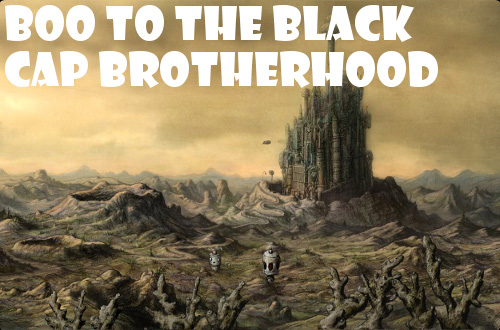
Josef the robot’s journey to stop the Black Cap Brotherhood

machinarium final ps3 impressions

In a perfect world, I would’ve continued playing Machinarium on the PC and without a walkthrough minimized on my laptop, hidden but always there at the ready. However, the deed is done, and I finally played through Amanita Design’s gorgeous automaton-themed point-and-click adventure game on the PS3, using a visual (and sometimes video) guide at nearly every step. This makes me hesitate to say that I “beat” it, but I guess I did, as I saw all there was to see, including the credits, and managed to solve a puzzle or two all on my own though I know in my heart of hearts that I never would have escaped the titular city without outside assistance.

Machinarium starts with our little robot Josef disassembled and tossed aside outside the city. As he puts himself together and makes his way back to mechanical civilization, a plot appears: the Black Cap Brotherhood is up to no good, bullying many and keeping Josef’s girl kidnapped in a small kitchen, as well as planting a bomb somewhere else in the city. At least that’s what I’ve put together based on playing the whole game all the way through, as well as some secondary sources to fill in the gaps. Since the game lacks any kind of straightforward narration, both in text and voice, it’s a lot of guessing what’s going on, though the single screen plot problems are generally very obvious.

To progress, you point and click. Except I’m playing Machinarium on the PlayStation 3, so instead you move a cursor with the analog stick and press a button. However, the end results are still the same. Unlike many other adventure games, you can’t just swoop the cursor across a screen to see where all the interactive items are and click until all have been grabbed; everything is relative to Josef, and items only light up if he is next to it and the right height. See, Josef can stretch up to be taller or squat down to be smaller, and finding certain items or solutions is often dependent on his size. I really like this, as it adds a certain realism to a game stark with sci-fi and steampunk, but it also makes for very challenging, sometimes frustrating gameplay. To learn that you were on the right track with a puzzle solution, but because Josef was standing a foot to the left was unable to see your idea come to fruition is a big bummer.

I appreciate the commitment by Amanita Design to a voiceless world, which shows in the hint and in-game walkthrough systems. If you select “hint,” Josef will use a think-bubble animation to show a clue for one of the puzzles on the screen, though the clue itself is not always clear and direct. For the “in-game walkthrough,” you have to play a mini-game wherein you control a key and shoot spiders in your way towards a keyhole; once beaten, you open up a book to an illustrated walkthrough that, again, is not always clear and direct, and because I’m playing on the PS3 and not sitting directly in front of my monitor, it can be hard to see what is what and what is where. The zoom function is nice, but it doesn’t zoom in far enough, if you ask me and my bad eyes.

I found most of the item-based puzzles to be relatively straightforward, if a bit tricky if you didn’t spot that one item you needed hidden in the corner of the room. However, the logic puzzles to open doors, locks, elevators, projectors, etc were beyond stumping. Took me back to my high school math class days, where I’d sit staring at a piece of graph paper, no idea how to even begin. Many broke my brain and detracted from the experience because as soon as I saw a panel of switches or knobs or lights and wires, I went right to the Internet to watch somebody else do it for me.

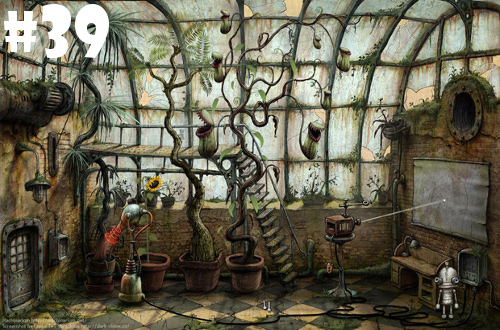
That grudgingly said, this game is worth seeing. Yes, yes, yes it is. Whether you have to pound your head against a wall until the solutions ooze out your ears, “cheat” and play the key mini-game to unlock the illustrated walkthrough provided by Amanita Design, or simply use an outside walkthrough that clearly says “use object A with object F to see the robot do a Hadoken.” However you need to go about it–go about it. Machinarium‘s visuals are a pure delight to take in; hand-drawn visuals mixed with fun, Pixar-like robot designs, and a soft, rusty color scheme really help sell the world as a cohesive state. There’s always stuff in the foreground and background to observe, and I love how rooms would just appear if you poked Josef’s head through a window or hole, materializing right before your eyes. If you can, let Josef go idle, and you’ll get to take a glimpse into some of his happier memories.

I guess now I just have to wait for Samorost 3 to come out. Hopefully the puzzle-solving areas of my brain have recovered by then…

2013 Game Review Haiku, #39 – Machinarium

2013 games completed machinarium

Josef the robot
Out to stop a bomb, only
If it’s in his reach

These little haikus proved to be quite popular in 2012, so I’m gonna keep them going for another year. Or until I get bored with them. Whatever comes first. If you want to read more words about these games that I’m beating, just search around on Grinding Down. I’m sure I’ve talked about them here or there at some point. Anyways, enjoy my videogamey take on Japanese poetry.